Tuesday, 29 April 2008

It's Just Not Cricket!

What do you keep a cricket in?
I knew a lovely lady who was from the US, but worked as a textile conservator in the UK. My conservation career started out with me volunteering for her at a museum. She was very popular, and had a wide social circle, into which I was invited. She loved antique things, and would invariably have some interesting trinket to show people. I remember one time when there was a gathering of friends, she was showing off a little round wicker box with a lid, that she had found in some junk shop, and we were debating what it could have been for. My friend thought that perhaps it was for keeping an insect in, so said that "it may be a cricket box". At this juncture, any Englishman worth his salt will know exactly why all the men in the group fell about laughing. I myself (being younger and shyer than most of the company who, to me, all seemed very knowledgeable about the world and life) was unsure of what the term "cricket box" actually meant to them, but was able to quickly guess that it was something to do with the game of cricket, and probably some sort of protection that only men would need!

Well, my education was completed recently, when my boy decided he wanted to take up cricket, and so joined a local village cricket club. The only essential equipment he needs at this beginning stage is a cricket bat, and of course, the famous box. We rushed around our local towns, and successfully found him one before his first match - this being the result.


Last night, he had his second match, but being in a rush to get there, he forgot to attire his nether regions in the appropriate under wear. Apparently, boxer shorts are not the right sort of thing to wear, as my lad found out to his cost - the box falls out! Well, his papa and I had done one of those brilliant parental changeovers, whereby, I had heated up his supper and taken it in an earthenware pot, while my husband was to meet us at the cricket pitch straight from his work, where he could then eat at his leisure. This was to save his darling wife from having to sit through the excruciating experience of watching an under 11's cricket match -have you heard the expression "watching paint dry", well that's how cricket leaves me feeling. (The match lasts TWO hours). I had wrapped said hot pot in a nice large tea cosy I have, to keep it warm till my beloved knight came to rescue me, and I felt quite proud of my wifely efficiency (I had to, it was a RARE occasion of such efficiency!)
When they got home, my son recounted the tale of the habitual trouncing.
It strikes me that he has probably joined the worst team in the County, which is possibly why he was so easily taken on, but I digress.
More importantly though, he was holding something out to me, and telling me that he had had problems with his box falling out. However, his ever-resourceful daddy had given him an alternative, which, when it was removed from down the front of his trousers, after his turn at batting, had caused the other boys on his team much merriment...

I suppose it was a good job he didn't have an opportunity to score any runs - he wouldn't have been able to run very fast with that stuck down his front!!!

(Footnote for my international readership - cricket is a game played with a VERY hard ball, which is thrown hard and fast directly towards a wicket, in front of which the batsman must stand to defend it with a bat - needless to say there are many opportunities for said ball to hit the batsman in a place that could cause a lot of pain if not covered with a tea cosy).

Monday, 28 April 2008

Maths avoidance sometimes brings benefits.

Today we should have continued with the maths programme we are using. There is a lot to cover in it, and we are already several weeks behind. This is due more to the fact that one would need to study for about 2 hours a day if one intended to keep up with it! I haven't been able to work out which bits could be skipped, so I plod through the lot! It's all good practice, I suppose. My dear son would not agree with me though. He is capable of the work, he just doesn't like doing it. He practised at the piano first thing - this is inevitably done as the lesser of two evils - he knows if he doesn't get on with it, mummy will call for the maths books to be brought out. Then, after a break, he managed to convince me he was working, by reading a book all about how electricity is made, moving on to another one, on how things work. The maths books were out, but he looked out of the window at the garden, and exclaimed, "Look, they're like electric light bulbs, cups, filled with the sun!" I wondered to what he was referring, and came to see - my white tulips, certainly were like cups filled with sunshine! So I suggested that would be a good starter for a poem, and off he went and wrote one - anything to get away from the maths, I suppose. And I trouped off down the garden to get some photos of the few floral exhibits I have therein, this spring - anything to get away from the maths, I suppose!
The poem was very good too, worth avoiding maths for!

(Edited next day to add)
I actually can't get over how brilliant these flower-heads are, so I'm posting this picture I took today, as well. Even though the light isn't as bright as yesterday, they really are radiant, like light bulbs!:-) The wonders of God's creation!


Sunday, 27 April 2008

Parable Meme


Rachel, at Chasing Butterflies, has asked me to do a parable meme, it seems quite straight-forward, list 5 favourite parables, and then tag the same number of people. I think I'll give the tagging bit a miss this time, as I found it hard to find 5 people for the last meme I did, but if anyone wants to join in, please do so.
It's funny, but apart from the really obvious parables, the prodigal son, the good Samaritan, and the Sower sowing seed on different grounds, I couldn't readily bring any others to mind, and didn't know if I even have favourite ones, but once I'd looked them up, there were of course, plenty to choose from.
1) I should have remembered the one about the unscrupulous judge and the widow who kept pestering him for justice. I still remember the little cartoon sketch my husband did for me to remind me of this one when, after we'd been married over a year and a half, we still hadn't conceived, and I felt like giving up praying for a child. It spurred me on to keep nagging our heavenly Father for what we wanted!
2) There were some lovely illustrated books I used to read to my little boy, or he'd look at during Mass when he was very small. I still remember the one about the two sons, one who says he'll do the Father's will, and doesn't, and the other who initially says he won't, but then thinks better of it and does help him out.
3)The selfish farmer, who builds bigger and bigger barns, to store all his grain for himself, and then dies the next day. Helps me to not put too much store in what happens (materially) to me in this life.
4)Lazarus and Dives. Apparently, according to my learned husband, (who I think got this from Scott Hahn) it is the only time a character in a parable is named, and one could identify the Lazarus in the parable of Luke with the real Lazarus in John, who Jesus actually did raise from the dead, yet the pharisees still didn't believe in Him. I was intrigued by this, it shows how much more depth there is to the parables than at first reading.
5)The wise and foolish virgins. It took me years to appreciate what this was all about - that's the trouble when you're young, you always empathise with the fools, and feel sorry for them, but that's because you are a fool yourself eh? Now, I realise the importance of being ready and waiting for the Lord, as the awareness of my own mortality grows.

Saturday, 19 April 2008

We have been graced.

We had a visitor round for dinner tonight. A Priest. We feel truly blessed that he came to our house. He also blessed our house, for which we are grateful. He asked us how we met, and we related our story. After he had gone, my husband expressed to me what he had felt, (which was what I had also felt), that it was like a renewal, being able to go back to how it all started between us, and how God acted in our lives.
Thank you Jesus, for this Priest.
Thank you Jesus, for all our Priests.
Thank you Jesus, for our marriage.
Amen.

Wednesday, 16 April 2008

God's Providence and Trench Warfare


Look what came out of the garden this morning. My boy decided to dig a trench in what was the potato patch last year, (it had something to do with trench warfare, I believe. I blame that dratted homeschooling family we know with six boys for introducing my little darling to the concept). I've been longing to dig it over, now that we are having some sunshine, and if I'd just asked him to do it for me, he would have run out of energy after the first spade-full, but as he decided, on his own initiative to dig a trench, and I knew this would be at least helpful in getting the plot dug, I let him have his fun. Mmm, I could get into this 'unschooling' type homeschooling. He found the small pile of spuds - they don't seem too bad considering they've been in the ground all winter. I then decided (since he'd got every single spade, fork, trowel and hoe out of the shed) it was about time to dig up some of the leeks and parsnips on the plot next to the ex-spud plot (can't use the same ground again this year for the spuds, apparently). Look at how well they've grown - well, by comparison to the three beans I got out of my fancy Italian bean crop last year. The reason there's plenty of them left, is that I don't really like parsnips, and only use leeks in moderation, and it's been so wet and murky all winter that I couldn't be bothered to make the (short) trip to the vegetable plot to dig 'em up!
Anyway, the lads love parsnips, so I suppose I'll just have to get my pal's curried parsnip soup recipe out (yeuch) and make it for them. What martyrdom we wives and mothers go through!


I thought the veggies on the edge of the sink would have made a good still-life, but by the time I would get round to painting it, they'd have self-composted.

That reminds me of a lad who was in my year at art school. He wasn't noted for his attendance record, so imagine our dismay when he came in one day with a dead fish to paint. Yes, it sat there for a week or two, waiting for him to come back and paint it - I can't remember how the situation was resolved, suffice to say, I was pretty glad I worked at the other end of the studio.


(We love the family with the six boys, by the way - they're expecting their 7th child in the Summer, aren't they blessed!)

Friday, 11 April 2008

Saints Leo the Great, and Guthlac of Crowland


Two great Saints share 11th April Feast Day.


LEO THE GREAT, POPE, DOCTOR OF THE CHURCH, died 461.

During the disintegration of the Western Empire, when heresy was rife and all moral values were threatened by the barbarian invasions, Pope Leo I stands out as the resolute champion of the faith. His courage and sagacity lifted the prestige of the Holy See mightily, and earned for him the title of "The Great," a distinction bestowed on but one other pope, Gregory I. The Church honoured Leo further with the title of Doctor because of his expositions of Christian doctrine, extracts from which are now incorporated in the lessons of the Catholic breviary. Of his birth and early years we have no reliable information; his family was probably Tuscan. In 440 he was consecrated Pope. Ninety six sermons of his have survived, in which we find Leo stressing the virtues of almsgiving, fasting, and prayer, and also expounding Catholic doctrine with clarity and conciseness, in particular the dogma of the Incarnation. Also one hundred and forty-three letters written by him, and thirty letters written to him, have been preserved; they illustrate the Pope's extraordinary vigilance over the Church in all parts of the Empire.

It's amazing how people think that the Catholic Church's teachings were all made up in the Middle Ages, and yet there is so much written evidence for Her beliefs from such an early age.

Pope Leo vigorously fought against several heresies - Manichaeanism - Priscillianism - Nestorianism, and its opposite, Eutychianism.
I love the names of these heresies, but it's so hard to get the spelling right!! They are fascinating to study, and if one does, one can see how they rear their ugly heads again in some of the theories that are put about today, even amongst people who call themselves Christians. It just shows how the Church needs a leader who can definitively guide her through the murky waters.

Basically, the Manichaeans had a theory that all matter was evil. The Priscillian sect had made great headway in Spain, and as it developed there, it seems to have combined astrology and fatalism with the Manichaean beliefs - has a New Age tinge to it doesn't it?
While Nestorius, bishop of Constantinople from 428 to 431, taught a doctrine of the humanity of Christ, according to which God the divine Son and Jesus the Man were always two distinct persons; Jesus alone was born of woman, and as a man of surpassing goodness became the dwelling place of the Word, which was incarnate in him. He was deposed and excommunicated by the Council of Ephesus. This was the Council that defined Mary as "Theotokos", ie, the Mother of God, a widely-held orthodox belief, that Nestorius preached against.
I have spoken with several Protestants who do not believe that Mary is anything other than an ordinary, good woman, not entirely sinless, but one who had a special role to play. I believe that if they can not see that Mary, defined so early on in the Church as the Mother of God, had to be sinless, then they do not fully understand her Son's Divinity or humanity. They end up making up a God to suit their beliefs, rather than allowing themselves to be led to the One True God by His Immaculate Mother.

Then Abbot Eutyches of Constantinople, was condemned by a synod in 449, for falling into heresy. In his writings it seemed clear that Eutyches had fallen into the error of denying the human nature of Christ, a heresy which was the opposite of Nestorianism.

Leo's “Tome” (written in 449 ) was read by his legates in 451, to a council which was held at Chalcedon. In it he concisely defined the Catholic doctrine of the Incarnation and the two natures of Christ, avoiding the pitfalls of Nestorianism on the one hand and of Eutychianism on the other. "Peter has spoken by the mouth of Leo!" exclaimed the bishops. This statement of the two-fold nature of Christ was to be accepted by later ages as the Church's official teaching.

So, any "Christians" who still don't believe that Jesus is Fully human and Fully divine, should get off the boat now! (And stop calling themselves Christian too!).


Our next wonderful Saint of the Day is said to be one of the most popular Saints among Englishmen prior to the Norman Conquest, second only to Saint Cuthbert.


He was born about 673, and died at Crowland, England, on 11 April, 714. The authority for the life of St. Guthlac is a monk called Felix, who, in dedicating it to King Æthelbald, Guthlac's friend, assures him that whatever he has written, he had derived immediately from old and intimate companions of the saint. Guthlac was born of royal blood, from the Mercian tribe of Guthlacingas. In his boyhood he showed extraordinary signs of piety; after eight or nine years spent in warfare, during which he never quite forgot his early training, he became filled with remorse and determined to enter a monastery. This he did at Repton (in what is now Derbyshire). Here after two years of great penance and earnest application to all the duties of the monastic life, (where he wasn't too popular because of his total abstinence from intoxicating drink - made all the others feel guilty, I suppose!) he became fired with enthusiasm to emulate the wonderful penance of the Fathers of the Desert. For this purpose he retired with two companions to Crowland, a lonely island in the dismal fen-lands of modern Lincolnshire. In this solitude he spent fifteen years of the most rigid penance, fasting daily taking only coarse bread and water. Apparently, he was tempted by the Devil, who came disguised as his (very holy) sister, Pega, who was also a hermit at Crowland, trying to get him to break his vow never to eat before sunset. To prevent further attempts of this nature, Guthlac ordered Pega to leave the island, and they never met again. The picture above is taken from a late 12th C. set of illustrations, usually called the Guthlac roll, now in the British Museum, and shows Pega being sent away. Thus Like St. Anthony he was frequently attacked and severely maltreated by the Evil One, and on the other hand was the recipient of extraordinary graces and powers. The birds and the fish became his familiar friends, while the fame of his sanctity brought throngs of pilgrims to his cell.
Guthlac, after his death, in a vision to Æthelbald, revealed to him that he should one day become king. The prophecy was verified in 716. During Holy Week of 714, Guthlac sickened and announced that he should die on the seventh day, which he did joyfully. The anniversary (11 April) has always been kept as his feast. Many miracles were wrought at his tomb, which soon became a centre of pilgrimage. His old friend, Æthelbald, on becoming king, proved himself a generous benefactor. Soon a large monastery arose, and through the industry of the monks, prospered. Felix's Latin "Life" was later turned into Anglo-Saxon prose by some unknown hand.

Two very inspiring men.

Wednesday, 9 April 2008

Suffering, or Miracle-Working?


Every morning my dear husband reads a page from a book entitled "A Year with the Saints" published by Tan, which he found in a souvenir shop in Lourdes. The readings are wonderful, and the excerpts from the Saints' lives and speech are inspiring.


I often think of the debates that are had in blogland. There was one blogger who liked to pop in to Catholic blogs and put in his (Ex-Catholic, now Evangelical Protestant) penny's worth in the comments boxes. He frequently berated Catholics, particularly those who liked to attend the Extraordinary Form of the Mass, for not performing miracles, whilst he claimed he, and his charismatic friends were causing miracles left right and centre, even raising people from the dead. He also took exception to the Catholic acceptance of suffering.
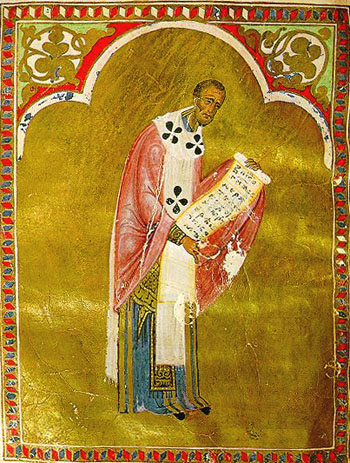
This morning's reading seemed very appropriate to this debate - it is from St. John Chrysostom, who lived from about 347 until his death in 407 AD.


"If the Lord should give you power to raise the dead, He would give much less than He does when He bestows suffering. By miracles you would make yourself debtor to Him, while by suffering He may become debtor to you. And even if sufferings had no other reward than being able to bear something for that God who loves you, is not this a great reward and a sufficient remuneration? Whoever loves, understands what I say."
The Saint set such a high value on suffering that he even said: "I venerate St. Paul not so much for having been raised to the third heaven, as for the imprisonmment he suffered. And so, if I were asked whether I would be placed in Heaven among the angels, or in prison with Paul, I would prefer the latter. And if it were left to my choice whether I should be Peter in chains, or the angels that released him, I would certainly rather be the first than the second."


Now there's a saint who goes back a long way, so our Catholic view of suffering isn't all a Mediaeval invention, after all! (As our Protestant friend would claim).


Now all I need is the grace to be able to stop waiting for miracles to happen, and just get down and accept all that suffering that I get thrown at me, with a great big, Thank You Jesus!